Pathogen
r/PathogenGame Join the beta

Cancer

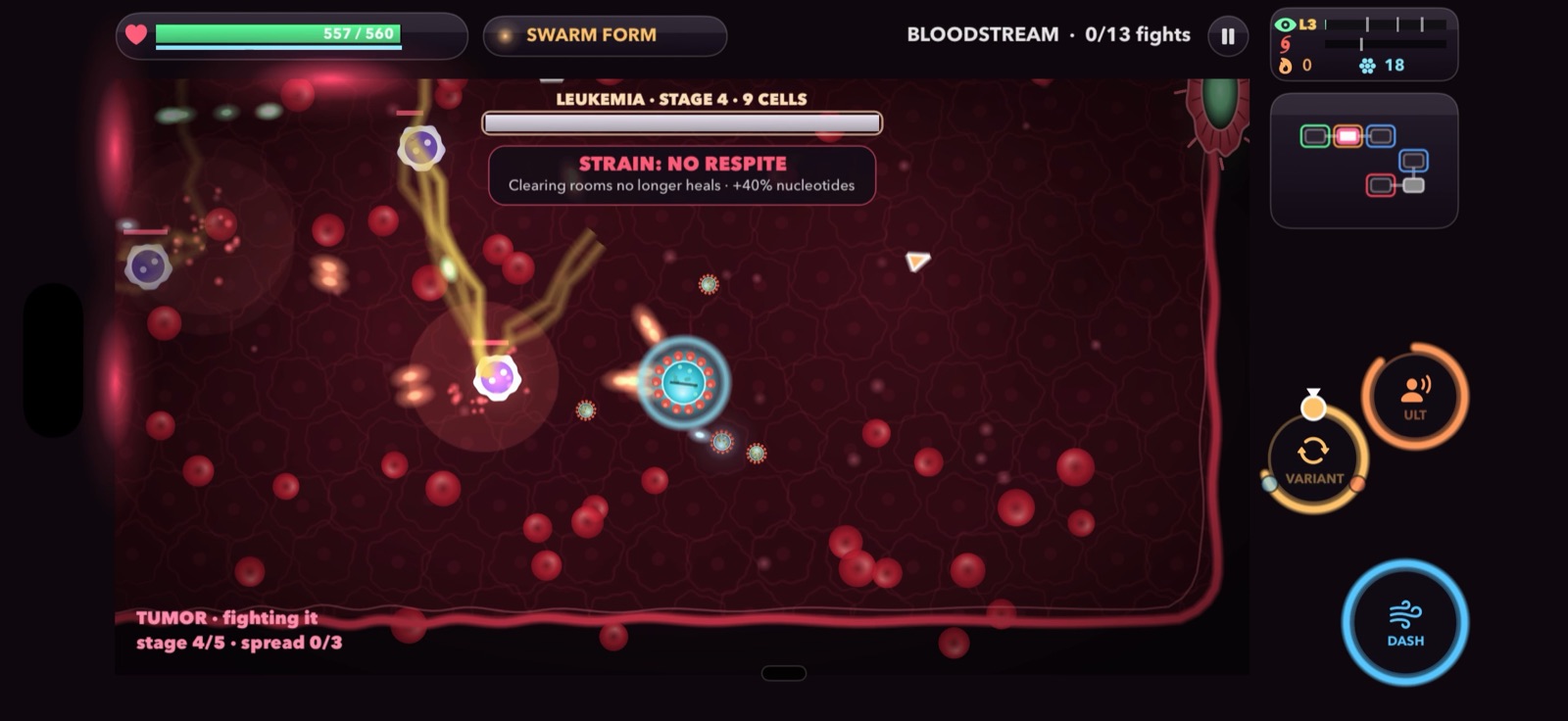
Once cancer unlocks, most organs grow a tumor on a timer. Leave it alive and it grows, spreads into other rooms, sends assassins after you and follows you into the next organ. Destroy it and you feast.

Cancer

Tumors & Metastasis

Once cancer unlocks, most organs grow a tumor that grows, spreads and follows you deeper if left alive. Destroy one and your virus feasts.

Tumors & Metastasis unlock

Unlocks later

Cancer unlocks for your whole save once any virus climbs far enough up its skill tree. Your next run introduces it with its own notice, and that organ is guaranteed a tumor.

  • Shows up in Infect Game Mode and Pandemic Game Mode, never Endless
  • Also unlocks cancer traits, modifiers and host conditions
  • A CANCER briefing card explains each new cancer and assassin

Tumor Room

Event room

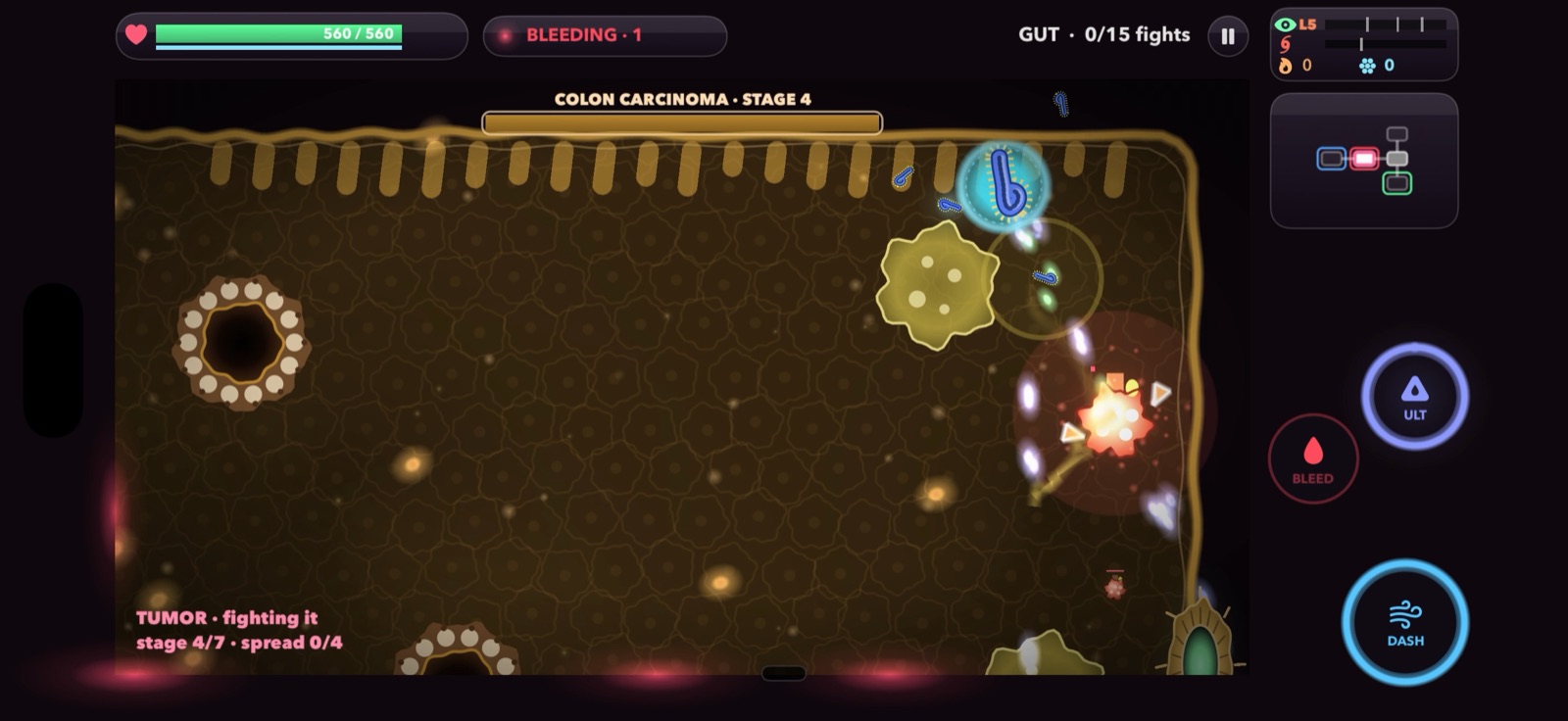
The room where an organ's cancer grows, marked pink on the minimap. Its doors never lock, so you can walk away mid-fight and come back when you're ready.

  • Bigger than a normal room, and it swells as the tumor grows
  • A boss-style health bar shows the cancer's name and stage
  • Destroy the core and the whole tumor collapses

Growth timer

Timer

While a tumor lives, a countdown in the corner shows when it will next grow or spread. It takes turns between the two, growing first, and ticks faster in deeper organs.

  • Turns red when the next tick is close
  • Pauses while you fight inside the tumor room
  • Stops once every tumor is dead or fully grown

Growth stages

Stages

Every growth tick pushes the cancer up a stage: a tougher core, more satellite cells crowding the room, and quicker, faster-firing attacks. Deeper organs let tumors grow through more stages.

  • Each stage adds more nodules, blasts, clones, polyps, lobes or nodes
  • Attacks come sooner and shots fly faster
  • Bigger tumors pay out more when destroyed

Spreading (local invasion)

Spread

Instead of growing, a tick can spread the cancer. It takes over an unexplored fight room or buds a brand-new tumor room onto the map, and every spread is another tumor to destroy.

  • Invaded rooms keep their immune cells, all attacking around the tumor
  • New tumor rooms never sprout beside the boss
  • Deeper organs let the cancer spread more often

Leaving mid-fight

Persistence

Walk out of a tumor fight and your progress is kept. Satellite cells you destroyed stay dead and the core keeps its damage, so you can retreat and finish the job later.

  • Liver lobes always grow back while you're gone
  • Growth while you're away still adds new satellite cells
  • Pools, lesions and tendrils clear when you leave

How tumor cells behave

Rules

Cancer cells play by their own rules. They never become elites, never lose track of you once alerted, and never adapt into Cytokine Storm cells the way other cells can.

  • Killing tumor cells never raises Detection
  • No elite tiers or affixes, ever
  • CRISPR cuts ordinary tumor cells apart, but cores resist

Eight cancers

A Different Cancer in Every Organ

Each organ grows its own real-world cancer with its own fight and weak point. The early organs share classic tumor parts; the deeper ones are fully unique.

Leukemia, the Bloodstream's cancer

Nasopharyngeal Carcinoma

Nasal Passage

A lumpy core ringed by satellite nodules that shield it and keep budding fast clone cells. Break the nodules first, and the exposed core goes down far more easily.

  • The core barely feels your hits while any nodule lives
  • Nodules keep budding fast clone cells that rush you
  • The core fires big volleys from the shared patterns

Lung Adenocarcinoma

Lungs

A growing core that keeps healing itself and launches metastasis seeds across the room. Any seed you don't shoot down takes root as a new nodule, making the core heal even faster.

  • Seeds drift toward pulsing pink rings on the floor
  • Every living nodule speeds up the core's regrowth
  • Nodules bud clone cells, just like in the Nasal Passage

Leukemia

Bloodstream

A crowd of white blast cells that keep dividing. One gold leukemic stem cell hides among them, and killing it collapses the whole leukemia at once.

  • The health bar counts how many cells are left
  • The stem cell spawns far off and retreats as you approach
  • Blasts keep dividing, so finding the stem cell fast matters

Lymphoma

Lymph Node

A germinal centre hidden in a crowd of identical lymphocytes. Most are harmless, but lymphoma clones lurk among them, and the core only turns soft while it swells to split.

  • Hit the core hard during its brief swelling window
  • A pink scan pulse makes hidden clones flicker their true face
  • Each swell ends in a ring of shots and new cells

Colon Carcinoma

Gut

A shell game: the core hides in one of several crypts, surfaces in another to fire, then dives again. Polyps along the walls drip caustic pools while you hunt it.

  • A ripple under the floor shows its next crypt, plus a decoy
  • Don't stand on a flashing crypt when it bursts out
  • It can't be hurt while hiding down in a crypt

Hepatocellular Carcinoma

Liver

A liver tumor fed by satellite lobes through pulsing vessels. While any lobe lives it heals and shrugs off damage, so drop every lobe at once to trigger cirrhosis.

  • Destroyed lobes regrow quickly, so work fast
  • Cirrhosis stops the healing and leaves the core extra vulnerable
  • Alternates between bile arcs and a bile spray

Multiple Myeloma

Bone Marrow

A malignant plasma cell drifting in slow circles, firing spirals of Y-shaped antibodies that lock on to you and punching bone lesions into the floor while its clones gather.

  • Antibody spirals lock on, so keep moving when they flare
  • Stay off the bone lesions it punches into the floor
  • Keeps budding myeloma clones that circle and shoot

Glioblastoma

Brain

A brain tumor rooted among glial nodes. Tendrils creep across the floor at you while the core hops between nodes, so cut the nodes down to leave it stranded and exposed.

  • A stranded core takes much more damage
  • Comes up firing pulse rings after every hop
  • The blood-brain barrier makes it tougher, like every Brain cell

Know your enemy

Cancer Cells & Tumor Parts

Every piece of every tumor fight, from the core at its heart to the satellites it buds.

Tumor core

Nasal Passage, Lungs

A lumpy, irregular mass of crusty nodules and tangled blood vessels. It never moves, hurts to touch and swells briefly before each attack. Destroy it and the whole tumor collapses.

Satellite nodule

Nasal Passage, Lungs

A smaller, stationary lump around the core that keeps budding clone cells. In the Nasal Passage it shields the core; in the Lungs it speeds up the core's regrowth.

Clone cell

Nasal Passage, Lungs

A small, misshapen cell with an oversized nucleus that rushes straight at you. One of the quickest cells in the fight but fragile, and ones budded mid-fight drop no nucleotides.

Metastasis seed

Lungs

A dark cell the lung tumor launches toward a pulsing pink ring. It drifts slowly, so shoot it down before it lands and takes root as a new nodule.

Leukemic blast

Bloodstream

A white cell almost filled by its nucleus. Blasts are fragile on their own, but they chase you down and keep dividing until the stem cell dies.

Leukemic stem cell

Bloodstream

The gold-tinted, glowing cell that drives the leukemia. It keeps its distance, circles you and fires small volleys. Kill it and every blast dies with it.

Harmless lymphocyte

Lymph Node

An ordinary small lymphocyte drifting around the follicle. It never attacks and touching it does no harm, but it looks exactly like a lymphoma clone.

Lymphoma clone

Lymph Node

A cancer cell wearing a harmless lymphocyte's face. Get close or hit it and it shows its swollen, notched nucleus (CLONE!), fires a spread and hunts you down.

Germinal centre

Lymph Node

The lymphoma core: a lymph follicle gone wrong, with a dark mantle of packed cells around a pale, swollen centre. It resists damage except while swelling, then splits off new cells.

Colon core

Gut

A tan, cauliflower-like adenocarcinoma riddled with malformed glands. It travels between crypts under the floor and can only be hurt during its brief time on the surface.

Crypt

Gut

A dark well in the gut lining, ringed by goblet cells, where the colon tumor hides. It flashes as a warning just before the tumor bursts out of it.

Polyp

Gut

A lumpy pink growth on a short stalk along the walls. It drips caustic pools toward you and keeps budding new polyps further along the wall.

Liver core

Liver

A dark red-brown mass built of hexagonal lobules flecked with green bile. It heals and shrugs off damage while any lobe lives, and turns grey and cirrhotic when every lobe falls at once.

Satellite lobe

Liver

A smaller hexagonal nodule joined to the core by a pulsing vessel. It feeds the core, spits slow bile gobs at you and regrows from a bud after being destroyed.

Myeloma core

Bone Marrow

A malignant plasma cell with an off-centre nucleus, stuffed with stored antibody and studded with Y-shaped M-proteins. It drifts in a slow circle, firing spirals and punching bone lesions.

Myeloma clone

Bone Marrow

A small oval plasma cell that keeps its distance, circling you and firing single Y-shaped antibodies. It's tougher than an ordinary clone cell, so don't ignore it.

Glioblastoma core

Brain

A purple mass with a dark, dead heart and a rim of crowded cells, reaching out with infiltrating processes. It's untouchable while travelling under the floor and more vulnerable once every node is gone.

Glial node

Brain

A slowly spinning, star-shaped tumor cell with long branching arms. Tendrils grow from it and the core hops between nodes. Destroyed nodes snap their tendrils back and stay dead.

Attacks

Tumor Attacks & Floor Hazards

Every attack is telegraphed by a quick swell. Classic cores never fire the same volley pattern back to back; deeper organs add their own attacks and floor hazards.

Ring

Shared volley

A full ring of shots bursting out from the tumor in every direction at once. Bigger tumors fire denser, harder-hitting rings, so look for the gaps and slip through.

Spiral

Shared volley

Twin arms of shots sweeping round in a spiral, turning clockwise or anticlockwise at random. Bigger tumors keep the spiral going longer, so read its direction early and move with it.

Aimed bursts

Shared volley

Quick spreads of shots fired straight at you in rapid bursts. They're the fastest shots of any shared pattern, and bigger tumors fire more bursts, so be ready to sidestep.

Double ring

Shared volley

A ring of shots, then a second, faster ring offset into the gaps of the first. The follow-up comes quickly, so the safe lane you just found closes fast.

Rotating cross

Shared volley

Streams of shots fired in a cross that turns as it fires. Bigger tumors keep it spinning for more waves, so circle with the rotation to stay in the gaps.

Wide fan

Shared volley

A wide, slow fan of large shots aimed at you. It's hard to slip through, and bigger tumors pack in more shots, so get out to the side early.

Metastasis launch

Lungs

The lung tumor fires seeds at spots on the floor marked by pulsing pink rings. Any that land grow into new nodules, and it launches them faster with every stage.

Uncontrolled division

Bloodstream

Leukemic blasts keep splitting into new blasts until the crowd hits its limit. Thinning them only buys time; the real fix is killing the stem cell, which stops it all.
Scan pulse

Lymph Node

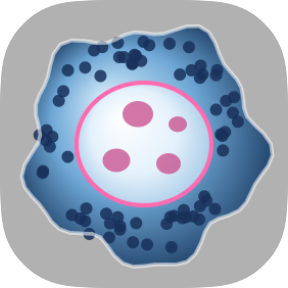
A pink ring rolls out from the germinal centre, and every hidden clone it passes briefly flickers its true face. It pulses more often as the tumor grows, so watch closely.

Swell & split

Lymph Node

The germinal centre swells and flashes as a ring grows round it, then splits with a burst of shots and fresh cells. That swelling window is your moment to hit it hard.

Crypt surfacing

Gut

The colon tumor bursts out of a flashing crypt behind a quick warning circle, hurting you if you're standing on top. Each time it dives, a decoy ripple heads to a different crypt.

Caustic drip

Gut

Polyps lob a glob toward you that leaves a caustic pool on the floor. The pool fades after a short while but hurts as long as you stand in it.
Bile arcs

Liver

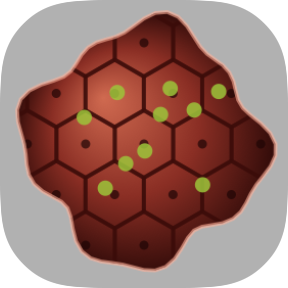
Globs of bile lobbed at you and around you, each landing in a warned circle and leaving a bile puddle. The first one leads your movement, so don't run in a straight line.

Bile spray

Liver

A line of bile splashes sweeping out from the core toward you. Each splash lands where a circle warns first, so step out of the line before it reaches you.

Bile gob

Liver

Each satellite lobe spits a slow green gob of bile at you whenever you're in range. On their own they're easy to dodge, but several lobes add up quickly.

Cirrhosis

Liver weak point

Bring every lobe down at the same time and the liver tumor's regeneration breaks. For a short while it can't heal and takes extra damage, then the lobes bud back one by one.
M-protein spiral

Bone Marrow

A spiral of Y-shaped antibodies that flare as a warning, then all turn at once toward where you're standing. They fly to where you were, not where you're going, so keep moving.

Bone lesions

Bone Marrow

Marked circles at and around you collapse into punched-out holes in the bone. The first lands right on you, and each hole keeps hurting for a while if you stand in it.

Antibody shot

Bone Marrow

Myeloma clones circle at range and fire single Y-shaped antibodies at you. Each shot is light on its own, but a few clones firing together can pin you down.

Creeping tendrils

Brain

Tendrils creep slowly across the floor toward you, hold briefly, then pull back, and touching one hurts. They grow from the nearest nodes and snap back fast when their node is destroyed.

Node hop

Brain

The core marks a spot by a node with a purple ring, shrinks, slips under the floor and travels there. It can't be hurt in transit, and with no nodes left it's stuck.

Pulse rings

Brain

As it surfaces, the glioblastoma fires rings of shots back to back, each with a gap to slip through on opposite sides. Find the first gap, then cross for the next.

Metastasis

It Follows You

Leave an organ with a tumor still alive and the cancer follows you into the next one, still growing and sending assassins after you.

Metastasis

Next organ

Leave an organ with a living tumor and the cancer comes with you, arriving in the next organ at the stage it reached. The leave prompt warns you before you go.

  • The next organ is guaranteed a tumor room, still able to grow
  • Assassin squads hunt you until every tumor there is dead
  • Never happens in Endless Game Mode

Radiation Therapy

After metastasis

Sometimes after a metastasis, the host fights back with radiation. The tumor shrinks a stage, but it scorches you too, cutting your health and leaving you with radiation sickness for a while.

  • Arrives a few seconds after the METASTASIS banner
  • The health loss is never lethal
  • Radiation sickness weakens your damage and slows you down

Cancer assassins

Assassin Squads

A metastasized cancer sends squads of assassin cells after you. Each organ's cancer sends its own kind with a twist, and every squad is bigger than the last.

Assassin squads

After metastasis

A red heartbeat warning, then a squad of nearly invisible cells arrives at the far entrance. They stalk you, mark a red line and pounce, and each bite leaves you taking extra damage.

  • Only while a metastasized tumor in the organ is still alive
  • Squads grow larger and come sooner as the tumor grows
  • Never in boss rooms or during a tumor fight

Squamous Stalker

Nasal Passage

A dart of layered keratin scales, the Nasal Passage cancer's assassin. It's the standard model: it stalks you nearly invisible, marks a line and pounces.

  • Cloaked at range, fully visible up close
  • Its bite marks you to take more damage

Lepidic Glider

Lungs

A lacy cell gliding on thin membrane wings. Its pounce glides further than any other assassin's, down a longer marked line, so backing away won't save you.

  • Step sideways out of its line instead of backing off
  • Its pounce lasts longer than other assassins'

Circulating Blast

Bloodstream

A blast cell bristling with needle-like Auer rods, and the fastest assassin of all. It closes the distance quicker than any other assassin, so react early.

  • Moves faster than any other assassin
  • Its bite marks you to take more damage

Owl-Eye Mimic

Lymph Node

Instead of cloaking, it disguises itself as an ordinary blue lymphocyte. Up close or when it strikes, it reveals its owl-eyed twin nuclei and pounces.

  • Never cloaked, but wears a harmless face at range
  • Shows its true face up close or when striking

Signet-Ring Burrower

Gut

A cell whose nucleus is squashed to the rim by mucus. It's almost completely invisible at range, though a little slower than the other assassins.

  • Far harder to spot at range than any other assassin
  • Watch for its marked line to know it's coming

Hepatoid Regenerator

Liver

A hexagonal cell threaded with green bile. Leave it alone for a moment and it starts healing itself, so once you start hitting it, don't stop.

  • Healing kicks in shortly after you stop hitting it
  • Keep the pressure on until it's gone

Lytic Stalker

Bone Marrow

A jagged bone shard. Wherever its pounce lands, it punches a small bone lesion into the floor that hurts to stand in for a short while.

  • Dodge the pounce, then step off the hole
  • Every pounce leaves a fresh lesion behind

Glial Infiltrator

Brain

A narrow cell trailing long, wavy processes. After its first pounce it re-aims and pounces again almost straight away, down a brand-new marked line.

  • The second pounce follows after only a short wind-up
  • Save your dash for the second pounce

The feast

Rewards for Destroying a Tumor

Rapidly dividing cells are a feast for a virus. Destroy the core and the whole tumor collapses at once, and the bigger it grew, the bigger the payout.

Tumor destroyed

Payout

TUMOR DESTROYED: every cell of the tumor dies with the core and a pile of loot drops. Deeper organs and bigger tumors pay more, and its hazards vanish from the floor.

  • Nucleotides, a chest, a mutation orb and chaperones
  • Almost always drops RNA in Pandemic Game Mode
  • A rare chance at a Dormant Virion, an extra life

Drops during the fight

Loot

Satellite parts pay a few nucleotides as you destroy them, so a tumor fight rewards you along the way. The core itself pays only when the whole tumor collapses.

  • Nodules, polyps, lobes and glial nodes each drop a few
  • Starting clones, blasts and lymphocytes sometimes drop some
  • Cells budded mid-fight pay nothing

Oncolytic

Challenge

Your first tumor challenge: destroy a single tumor. It's the opening step of the tumor challenge ladder and a gentle nudge to take on your first cancer.

  • Destroy your first tumor
  • First step of the tumor challenge ladder

Tumor Hunter

Challenge

The middle step of the tumor challenge ladder. Once you've got the hang of tumor fights, destroy a handful of them to complete it.

  • Destroy a handful of tumors
  • The step after Oncolytic on the ladder

Remission

Challenge

The top step of the tumor challenge ladder, for dedicated cancer hunters. Destroy a large number of tumors to finish the ladder and prove your virus is truly oncolytic.

  • Destroy a large number of tumors
  • Top step of the tumor challenge ladder

Cancer Day

Daily challenge

A daily challenge that asks for just one thing: find a tumor today and destroy it. A simple goal that fits into any run once cancer is unlocked.

  • Destroy a tumor today
  • Any organ's cancer counts

Tumor Week

Weekly challenge

A weekly challenge: destroy a few tumors before the week is out. There's no rush, so you can chip away at it across several runs.

  • Destroy a few tumors this week
  • Any organ's cancer counts

Discover tumor rooms

Exploration challenge

Exploration challenges can ask you to discover tumor rooms, either one or several. Keep an eye on the minimap for pink rooms as you explore each organ.

  • Find a single tumor room, or several
  • Tumor rooms show up pink on the minimap

Oncolytic virus

Traits & Hosts That Change Cancer

Real oncolytic viruses are engineered to burst cancer cells. In Pathogen, traits, modifiers, hosts and a city policy make tumors weaker, richer, faster or more common.

Oncolytic Payload

Cancer trait

A Cancer trait from mutation orbs that makes you hit tumors and all their cells harder, assassins included. Rarer versions hit harder still, and picking it again stacks.

  • Comes in every rarity from Common to Prismatic
  • Offered only after cancer unlocks, and less often than most
  • Stacks with other tumor-damage bonuses

Oncolytic Strain

Run modifier

A run modifier crafted between runs. Tumors take far more damage and pay out far more, but the catch is that every organ grows a tumor.

  • Turns every organ into a tumor hunt
  • Found in the Power-ups & tumors group
  • Pairs with Carcinogen Exposure for the Tumor Harvest combo

Carcinogen Exposure

Run modifier

A run modifier crafted between runs for bigger rewards. Tumors pay out much more, but they grow much faster and start a stage bigger, so you have less time to react.

  • Tumors start already grown a stage
  • Richer payouts in exchange for quicker tumors
  • Combines with Oncolytic Strain for Tumor Harvest

Tumor Harvest

Modifier combo

Load Oncolytic Strain and Carcinogen Exposure together and every tumor you destroy heals you fully. A great reason to go hunting cancers with both modifiers on.

  • Needs Oncolytic Strain and Carcinogen Exposure
  • Every destroyed tumor restores your full health

Cancer Cartel

Modifier combo

Stack Oncolytic Strain, Carcinogen Exposure and Nutrient Cache together and tumors pay out even more, while destroying one heals you fully. A rich reward for loading all of them.

  • Needs Oncolytic Strain, Carcinogen Exposure and Nutrient Cache
  • Bigger tumor payouts plus a full heal

Metastatic Cancer

Host condition

The host is riddled with cancer. Every organ grows a tumor that starts a stage bigger, grows faster and spreads further, but tumors pay out much more and so does the whole run.

  • Every organ is guaranteed a tumor
  • Tumors grow faster and spread further
  • Bigger rewards from tumors and the whole run

Chemotherapy

Host condition

The host is on chemotherapy. The drugs weaken immune cells and make tumors easier to destroy, but they poison you too, lowering your max health.

  • Tumors take more damage
  • Immune cells are frailer and hit softer
  • You have less max health

Strong p53 Gene

Good host trait

A helpful host gene: p53, the guardian of the genome, slows tumor growth. The rarer the host, the stronger the effect, giving you more time to deal with each cancer.

  • Tumors grow more slowly
  • Rarer hosts slow them even more

BRCA Mutation

Bad host trait

A harmful host gene found only in people. Cells can't repair their DNA, so cancers grow faster and spread further, and rarer hosts make it worse.

  • Tumors grow faster, more so on rarer hosts
  • Tumors can spread an extra time

Contingencia Ambiental

Pandemic city policy

Take Mexico City in Pandemic Game Mode and this policy puts a tumor in every organ. They grow faster than usual, but each one pays out far more.

  • A tumor in every organ
  • Faster growth, bigger payouts

CRISPR vs. tumors

Power-up

While CRISPR is active, ordinary tumor cells you touch are cut apart instantly. Tumor cores and the leukemic stem cell resist being cut, but still take heavy damage with every touch.

  • Ordinary tumor cells are sliced apart on contact
  • Cores and the stem cell take heavy damage per touch

Next up

In a Run

Procedural organs, traits that stack into chaos, power-ups, synergies and secrets.